Tag: Renaissance Art
-
Who Painted the Lady in Ermine? Sofonisba or El Greco? Biography not Brushstrokes convinces: It’s Sofonisba, Cradle to Grave
The details of Sofonisba Anguissola’s life show that she had the physical and geographical opportunity to paint a mature Catalina Micaela that her male contemporaries El Greco and Coello did not being far away in Spain. Sofonisba also had personal insight into the Infanta’s private world to render the Infanta of Spain, Catalina Micaela, as…
-
Sofonisba Was Not Always Forgotten

In 1774, Giambattista Zaist wrote Notizie Istoriche de’ Pittori, Scultori, ed Architetti Cremonesi or Historical Notes of Painters, Sculptors, and Architects of Cremona. For seven pages he writes about the accomplishments of Sofonisba Anguissola, recounting her early years, her time in Spain, her long legacy. He concludes with these words, “che superò l’artifizio non solo…
-
Sofonisba in the Seventeenth Century
Sofonisba Anguissola continued painting well into her senior years and stopped only after her eyesight failed, as Anthony van Dyck noted in his sketchbook. The Palazzo Abatellis in Palermo attributes this sweet Madonna and Child to Sofonisba in the seventeenth century.
-
Sofonisba Painted Catalina Micaela, the Lady in Ermine, Infanta of Spain, as a child and an adult
Sofonisba Anguissola first painted Catalina Micaela, Infanta of Spain, the Lady in Ermine, when Catalina Micaela was a child. Sofonisba Anguissola rendered a miniature painting of each Infanta of Spain in a Book of Hours, previously owned by the French King Francois I who passed it to his daughter in law Catherine de Medici on…
-
Sofonisba and the Habsburg-Valois Royal Wedding 1560
Sofonisba was one of the 17 original ladies in waiting chosen for the court of the new fourteen year old Spanish queen, the former Elisabeth de Valois, daughter of Henry II of France and Catherine de Medici. Eight Spanish noblewomen and eight French noblewomen comprised the rest of the young queen’s court. Sofonisba stood out…
-
Sofonisba’s Brush Rises to the Level of Titian’s
In 1563, Giovan Paolo Lomazzo praised Sofonisba in his Sogni, “Una femina Cremonese, della quale il nome e’ detto Sofonisba…molti pittori vallenti hanno giudicati quella avere il pennello levato di mano al divino Tiziano…” (Cremona Catalogue, 404). “A Cemonese woman called Sofonisba…many painters judge her brush to be elevated to the level of the divine Titian.”…
-
September 1549
In September 1549, the future King of Spain Philip II, paraded through Cremona, Lombardy during a tour of his future realm. Sofonisba Anguissola would have caught her first glimpse of him then, during The Prince’s Parade.
-
Sofonisba’s Influence on Giorgio Vasari
The 16th century artist, critic, and historian Giorgio Vasari is best known for his voluminous Lives of the Artists series where he painstakingly documents the biographies and styles of the great Renaissance masters. Master portraitist Sofonisba Anguissola inspired Giorgio Vasari. In 1566, Giorgio went to Cremona in Northern Italy to visit Sofonisba’s childhood home. Sofonisba…

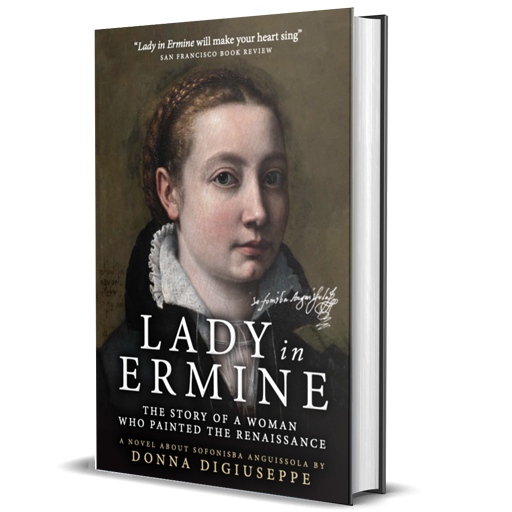
 Lady In Ermine: The Story of A Woman Who Painted The Renaissance