-
October 1559, The Duke of Sessa, Brocardo Persico, and Sofonisba Anguissola
From The Duke of Sessa, Governor of Milan, 14 October 1559 to the Philip II, King of Spain: Sofonisba is ready On October 14, 1559, the Duke of Sessa, a Spaniard stationed in Milan to govern the region on behalf of the Spanish King Philip II, wrote to his monarch “Vuestra Majestad” to confirm that…
-
A Few Women Artists of the Renaissance & Baroque: Sofonisba was not alone
via A Few Women Artists of the Renaissance & Baroque: Sofonisba was not alone
-
Sofonisba, Spanish Court, September 1559
In September of 1559, Amilcare Anguissola wrote as a devoted and obedient vassal “devotissimo, et ubidiente vassallo” to Philip II, the King of Spain, to accept the summons sent to his very dear daughter Sofonisba “me tanto carissima figliola” to serve as a lady in waiting to the next Queen of Spain “Serenissima nostra Regina”…
-
September 1549
In September 1549, the future King of Spain Philip II, paraded through Cremona, Lombardy during a tour of his future realm. Sofonisba Anguissola would have caught her first glimpse of him then, during The Prince’s Parade.
-
Sofonisba’s Influence on Giorgio Vasari
The 16th century artist, critic, and historian Giorgio Vasari is best known for his voluminous Lives of the Artists series where he painstakingly documents the biographies and styles of the great Renaissance masters. Master portraitist Sofonisba Anguissola inspired Giorgio Vasari. In 1566, Giorgio went to Cremona in Northern Italy to visit Sofonisba’s childhood home. Sofonisba…
-
Sofonisba’s Influence on Diego Velazquez
Maria Kusche and Sylvia Ferino-Pagden have shown the influence of Sofonisba’s Portrait of Margaret of Savoy with Dwarf (c.1595) on two of Diego Velazquez’ pieces: his Portrait of Prince Baltasar Carlos (1632 Boston, Museum of Fine Arts) and his 1656 Las Meninas, particularly in the way Velazquez poses a vessel that passes between the figures.…
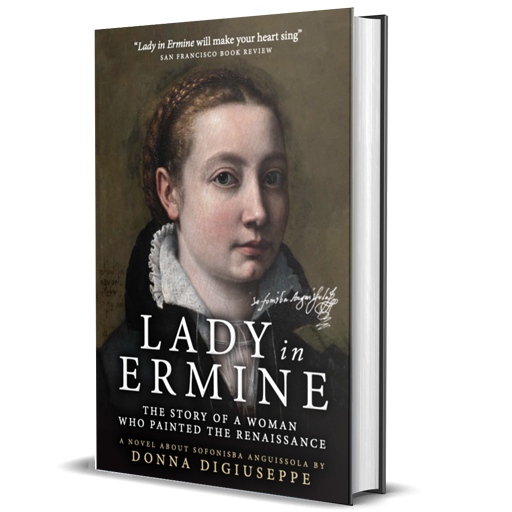
Lady In Ermine: The Story of A Woman Who Painted The Renaissance
by Donna DiGiuseppe
 Lady In Ermine: The Story of A Woman Who Painted The Renaissance